
Achilles tendon pain can make walking, running, climbing stairs, and everyday activities uncomfortable. For some patients, the discomfort develops gradually and continues for weeks or months.
One common cause is Achilles tendinopathy, a condition involving changes in the tendon that connects the calf muscles to the heel bone.
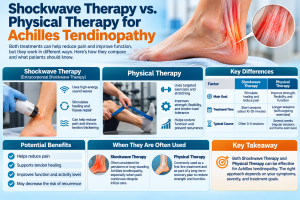
Two treatments patients may hear about are shockwave therapy and physical therapy. Both aim to improve pain and function, but they work differently and have different levels of scientific evidence.
At Orange County Foot & Ankle Institute, Dr. Amir Lebaschi, DPM evaluates Achilles tendon pain to identify the underlying problem and recommend appropriate treatment options.
What Is Achilles Tendinopathy?
Achilles tendinopathy is a condition that affects the Achilles tendon, the strong band of tissue connecting the calf muscles to the heel bone.
The Achilles tendon plays an important role in walking, running, jumping, and pushing off the ground.
Repeated stress or sudden changes in activity can overload the tendon. Over time, this may lead to pain, stiffness, thickening, and changes in tendon structure.
Common symptoms include:
- Pain at the back of the heel or lower leg
- Morning stiffness around the Achilles tendon
- Tenderness when touching the tendon
- Pain during running or jumping
- Swelling or thickening around the tendon
- Discomfort when climbing stairs
- Pain that worsens with increased activity
- Reduced strength when pushing off the foot
Symptoms may improve temporarily with rest but return when activity increases.
What Causes Achilles Tendinopathy?
Achilles tendinopathy often develops when the tendon experiences more stress than it can tolerate.
Common contributing factors include:
- Sudden increases in running or exercise
- Repetitive jumping or sprinting
- Tight or weak calf muscles
- Inadequate recovery between activities
- Changes in footwear
- Limited ankle mobility
- Training on hills or uneven surfaces
- Foot mechanics that affect tendon loading
- Age-related changes in tendon structure
- Previous Achilles tendon injuries
Certain medications and medical conditions can also affect tendon health.
Identifying these factors is important because treatment should address the underlying source of tendon overload.
What Is Shockwave Therapy?
Shockwave therapy, also called extracorporeal shockwave therapy (ESWT), is a noninvasive procedure that delivers acoustic pressure waves to the affected area.
It does not involve electrical shocks or surgical incisions.
A healthcare professional places a treatment device against the skin near the painful tendon. The device delivers controlled pressure waves into the surrounding tissues.
Researchers have investigated whether this treatment can influence pain signaling and stimulate biological responses involved in tissue repair.
However, these proposed effects do not guarantee that shockwave therapy will heal a damaged tendon.
How Shockwave Therapy May Help Achilles Tendinopathy
Some patients experience less pain or improved function after shockwave therapy.
Potential effects under investigation include:
- Changes in pain signaling
- Stimulation of local biological responses
- Possible changes in tendon-related tissue activity
- Reduced discomfort during rehabilitation
- Improved tolerance of daily movement
- Reduced discomfort during rehabilitation
Treatment typically involves one or more sessions, depending on the device and protocol.
Some patients experience temporary soreness, redness, swelling, or bruising afterward.
Importantly, recent research has not demonstrated a consistent, clinically meaningful benefit of shockwave therapy over comparison treatments for Achilles tendinopathy.
A 2026 systematic review found insufficient evidence to recommend ESWT as a routine treatment for either insertional or midportion Achilles tendinopathy.
Therefore, shockwave therapy is better viewed as an optional treatment whose benefits and limitations require careful discussion.
What Is Physical Therapy for Achilles Tendinopathy?
Physical therapy is a rehabilitation approach that focuses on improving tendon strength, mobility, and tolerance to activity.
Unlike shockwave therapy, physical therapy generally requires active participation through prescribed exercises and progressive strengthening.
The goal is to help the Achilles tendon gradually tolerate the forces involved in walking, running, and other daily activities.
Physical therapy may include:
- Progressive calf strengthening
- Eccentric heel-raise exercises
- Slow, controlled resistance training
- Ankle mobility exercises
- Balance and stability training
- Activity modification
- Walking and movement assessment
- Education about managing tendon pain
- Gradual return-to-sport training
The exercises should match the location and severity of the tendon problem.
Why Tendon-Loading Exercises Matter
Progressive tendon-loading exercises are a central part of Achilles tendinopathy rehabilitation.
These exercises gradually expose the tendon to controlled force, helping improve strength and functional capacity.
For example, a rehabilitation program may begin with manageable calf exercises and gradually increase resistance as symptoms and strength improve.
Eccentric exercises emphasize muscle control while the calf muscle lengthens. Other programs may use slow, heavy resistance exercises.
Both approaches can be useful when appropriately prescribed.
The 2024 clinical practice guideline from the American Physical Therapy Association recommends tendon-loading exercises as a first-line treatment for midportion Achilles tendinopathy.
However, rehabilitation should be individualized. Exercises appropriate for midportion tendinopathy may need modification when symptoms occur directly at the tendon attachment on the heel.
Shockwave Therapy vs. Physical Therapy: The Main Differences
Although both treatments aim to reduce symptoms, their methods and evidence differ.
| Feature | Shockwave Therapy | Physical Therapy |
| Treatment method | Acoustic pressure waves | Exercises and rehabilitation |
| Main approach | Device-based treatment | Progressive tendon loading |
| Patient participation | Primarily passive during treatment | Active exercise participation |
| Treatment schedule | Usually several appointments | Repeated exercises over weeks or months |
| Primary goal | Attempt to reduce pain and improve function | Improve strength, function, and load tolerance |
| Evidence | Mixed; no consistent meaningful advantage established | Stronger support for midportion Achilles tendinopathy |
| Role in care | Optional in selected circumstances | Recommended first-line approach |
The best approach depends on the tendon condition, symptom duration, medical history, and response to treatment
Which Treatment Is More Effective?
Current clinical evidence generally supports progressive exercise-based rehabilitation as the first-line approach for midportion Achilles tendinopathy.
Physical therapy helps patients gradually build tendon strength and improve tolerance to everyday activities.
Shockwave therapy has produced encouraging results in some individual studies. However, more recent systematic reviews have questioned whether the benefits are clinically meaningful.
A 2026 systematic review and meta-analysis found no consistent meaningful improvement in pain or disability from shockwave therapy compared with control interventions.
This does not mean every patient will have the same experience. It means the available research does not justify treating ESWT as a superior or routinely recommended alternative to exercise rehabilitation.
For most patients, appropriately supervised progressive loading remains the more established starting point.
Can Shockwave Therapy and Physical Therapy Be Combined?
Some treatment programs combine shockwave therapy with exercise-based rehabilitation.
The reasoning is that shockwave therapy might provide symptom relief while exercises help improve tendonstrength and load tolerance.
However, research has not consistently shown that adding shockwave therapy produces better outcomes than a well-designed exercise program alone.
Patients should understand the potential benefits, costs, uncertainties, and available alternatives before considering combined treatment.
Physical therapy remains important even when another treatment is used.
How Long Does Recovery Take?
Achilles tendinopathy recovery varies between patients.
Some people notice improvement within several weeks. Others may need several months of consistent rehabilitation.
Recovery depends on factors such as:
- Duration of symptoms
- Tendon location
- Severity of the condition
- Activity level
- Strength and mobility
- Previous injuries
- Treatment consistency
- Other medical conditions
Symptoms may fluctuate during rehabilitation.
A gradual return to activity is usually safer than immediately resuming high-impact exercise when pain begins to improve.
Improvement in pain does not always mean the tendon has fully regained its previous capacity.
Other Treatment Options for Achilles Tendinopathy
In addition to physical therapy, a podiatrist may recommend other treatments based on the patient’s condition.
Options may include:
- Activity modification
- Supportive footwear
- Temporary heel lifts
- Custom orthotics when appropriate
- Ice for temporary symptom relief
- Selected pain medications
- Short-term immobilization in certain cases
- Treatment of contributing biomechanical problems
- Further imaging or specialist evaluation
Surgery is generally reserved for selected patients with persistent symptoms or structural problems that have notimproved with appropriate nonsurgical care.
The treatment plan should also distinguish Achilles tendinopathy from a partial tear, complete rupture, bursitis, or other causes of posterior heel pain.
When Should You See a Podiatrist?
Schedule a podiatric evaluation if you experience:
- Persistent pain behind the heel
- Morning Achilles tendon stiffness
- Swelling or thickening around the tendon
- Pain during running or jumping
- Difficulty climbing stairs
- Discomfort when pushing off the foot
- Recurrent pain after exercise
- Reduced ankle or calf strength
- Symptoms that do not improve with activity changes
- Achilles pain that interferes with daily activities
Seek urgent medical care if you experience a sudden pop at the back of the ankle, severe pain, or a sudden inability to push off or stand on your toes.
These symptoms may indicate an Achilles tendon rupture rather than routine tendinopathy.
The Bottom Line
Shockwave therapy and physical therapy are different approaches to managing Achilles tendinopathy.
Shockwave therapy uses acoustic pressure waves and may provide symptom relief for some patients. However, recent research has not established a consistent, clinically meaningful benefit that supports its routine use.
Physical therapy focuses on progressive strengthening, tendon-loading exercises, and restoring functional movement. It remains a first-line treatment for midportion Achilles tendinopathy.
At Orange County Foot & Ankle Institute, Dr. Amir Lebaschi, DPM evaluates Achilles tendon pain, tendon function, and foot mechanics to develop individualized treatment plans.
If Achilles tendon pain continues to affect walking, sports, work, or daily comfort, an early podiatric evaluation can help identify the cause and determine the most appropriate treatment approach.
Medical References
APTA – 2024 Clinical Practice Guideline for Achilles Tendinopathy
https://www.orthopt.org/uploads/content_files/files/Achilles_Pain_revision_2024.pdf
2026 Systematic Review – Shockwave Therapy for Achilles Tendinopathy
https://pubmed.ncbi.nlm.nih.gov/42063301
AAOS – Achilles Tendinitis
https://www.orthoinfo.org/diseases–conditions/achilles-tendinitis
Publishing Note
This blog discusses shockwave therapy as a treatment option, but does not state that the clinic provides it.
Confirm the clinic’s available services before making service-specific claims.