
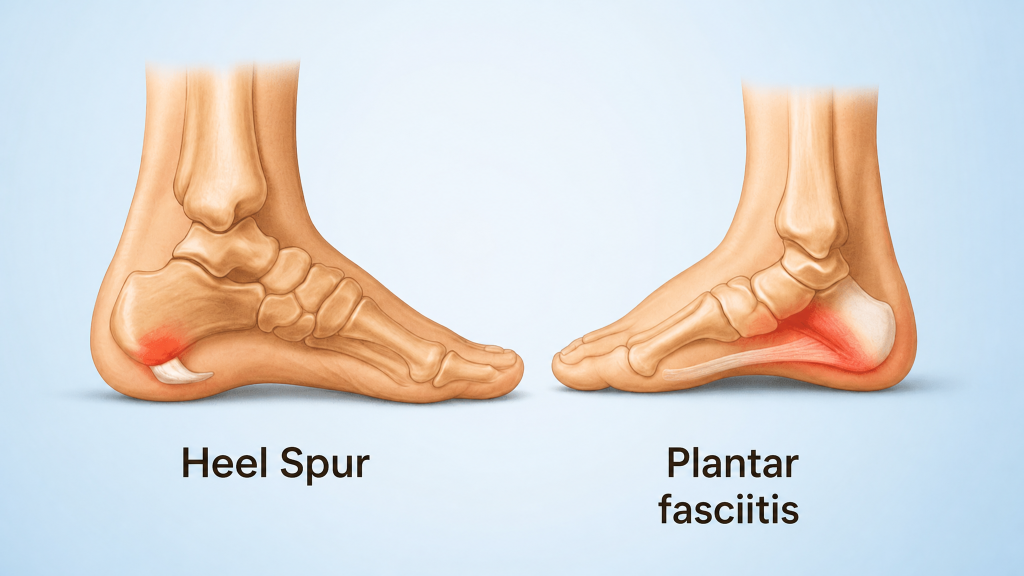
Many patients use the terms plantar fasciitis and heel spur as if they mean the same thing. They do
not. They are related, but they are not identical. Plantar fasciitis is inflammation or irritation of the
plantar fascia, the thick band of tissue along the bottom of the foot that connects the heel bone to
the toes. A heel spur is a calcium deposit that forms on the heel bone.
This distinction matters because many people are told they have a “heel spur” and assume the spur
is the main reason for their pain. In reality, heel pain is often coming from the irritated plantar fascia,
not from the bony spur itself.
What is plantar fasciitis?
Plantar fasciitis is one of the most common causes of heel pain. It happens when the plantar fascia becomes irritated from repeated stress, overload, or tightness. Patients often feel pain on the bottom of the heel, especially with the first few steps in the morning or after sitting for a long time. That pain may ease after moving around a bit, then return later with prolonged standing or activity.
The plantar fascia is designed to absorb stress, but too much strain over time can cause small tissue injury and persistent inflammation or degeneration. Overuse, long hours on hard surfaces, poor support, tight calf muscles, flat feet, and high arches can all contribute.
What is a heel spur?
A heel spur is a bony growth that forms where the plantar fascia attaches to the heel bone. It usually develops over time in response to chronic pulling and stress at that attachment point. On an X-ray, it may look like a small hook or projection of bone coming off the heel. The important point is this: many people have heel spurs and no pain at all.
How are they related?
Plantar fasciitis and heel spurs often show up together, but one does not automatically mean the other is the problem. Long-standing strain on the plantar fascia can contribute to spur formation. That means the spur is often more like a sign of chronic stress than the true pain generator.
This is why many patients improve without having the spur removed. If the actual problem is plantar fascia irritation, treatment should focus on reducing inflammation, improving support, and correcting he mechanical strain on the foot.
How can you tell the difference?
In real life, you usually cannot diagnose the difference based on one symptom alone. Both can be associated with pain near the heel. However, plantar fasciitis has a classic pattern: pain under the heel that is often worst with the first steps in the morning or after rest. Heel spurs are often found on imaging and may not cause symptoms by themselves.
That is why a proper exam matters. A podiatrist looks at where the pain is located, when it happens, how the foot functions, and whether imaging is actually relevant to the symptoms. An X-ray may show a heel spur, but that does not automatically prove the spur is causing the pain.
What actually helps?
For plantar fasciitis, treatment often focuses on reducing strain on the plantar fascia. That may include stretching, supportive footwear, orthotics, activity changes, icing, and other conservative care.
In many patients, the goal is not to remove a heel spur. The goal is to calm the irritated tissue and improve how the foot handles pressure. Since heel spurs are often not the true source of pain, many people get better by treating the plantar fasciitis and underlying mechanics instead of focusing on the bone spur itself.
When should you get checked?
- it keeps coming back
- it hurts with your first steps in the morning
- it affects walking, work, or exercise
- home treatment is not helping
- you are not sure whether the pain is plantar fasciitis, a heel spur, or something else
Heel pain can have more than one cause, so the best treatment starts with the right diagnosis.
The bottom line
Plantar fasciitis is irritation of the plantar fascia. A heel spur is a bony growth on the heel bone. They are often related, but they are not the same condition. In many cases, the pain comes from plantar fasciitis, while the spur is simply something seen on X-ray.
At Orange County Foot & Ankle Institute, we evaluate heel pain carefully to determine whether the problem is plantar fasciitis, a heel spur, or another condition entirely. If your heel pain is not improving, a proper exam can help you get the right treatment sooner.