
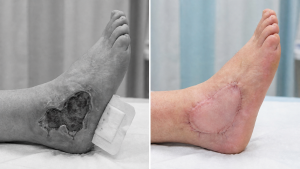
A foot wound that will not heal can become a serious problem. This is especially true when diabetes, poor circulation, pressure, or infection is involved. Some wounds improve with standard wound care. Others need more advanced treatment. In some cases, skin grafting can help close the wound and protect the foot.
At Orange County Foot & Ankle Institute, we want patients to understand that skin grafting is not the first step for every wound. We usually consider it when a wound is large, slow to heal, or unable to close on its own. It can also help after surgery, trauma, or tissue loss.
What is a skin graft?
A skin graft is a procedure that moves healthy skin from one area of the body to another area that needs coverage. The goal is to protect the wound and help it heal.
Doctors place the graft over the wound after they prepare the area. The wound bed must be healthy enough to support healing. If the tissue underneath is not ready, the graft may not heal well.
When is skin grafting needed for a foot wound?
Your podiatrist may recommend skin grafting when a foot wound is too large to heal well on its own. It may also be used when skin has been lost after trauma, surgery, or chronic wound breakdown.
Skin grafting may help with:
- non-healing foot wounds
- some diabetic foot wounds
- post-surgical wounds
- traumatic skin loss
- wounds left open after damaged tissue is removed
Not every wound is ready for a graft right away. First, we need to control the cause of the problem.
What has to happen before a graft is considered?
Before we place a skin graft, we must prepare the wound carefully. This step is very important. A graft has a better chance of success when the wound is clean, healthy, and stable.
We usually look at several things first:
- infection control
- removal of dead or damaged tissue
- blood flow to the foot
- pressure on the wound
- diabetes control and overall healing ability
If infection is still present, the wound usually needs treatment first. Poor blood flow can delay healing. When the wound is on a pressure area, we must reduce that pressure so the graft can heal.
How does skin grafting help?
Skin grafting helps by covering an area where skin is missing or badly damaged. That coverage protects the tissue underneath and supports wound closure.
On the foot, this matters a lot. The skin on the foot deals with pressure, friction, and daily stress. An open wound in this area can break down again and again if it does not get proper protection.
A successful graft can help:
- cover exposed tissue
- support healing
- reduce ongoing wound breakdown
- lower the risk of deeper damage
- improve protection in a high-stress area
Still, the graft alone does not fix the original cause. If pressure, poor blood sugar control, poor circulation, or shoe friction continue, the wound can come back.
Is every foot wound a good candidate for a skin graft?
No. Some wounds are not ready for grafting. Others need a different treatment plan.
A skin graft may not be the best option when:
- infection is still active
- blood flow is too poor
- the wound is too deep
- exposed bone or tendon requires more complex coverage
- the patient cannot keep pressure off the area
Sometimes a flap procedure works better than a simple graft. The right choice depends on the wound, the tissue involved, and the blood supply.
What is recovery like after skin grafting?
Recovery depends on the size of the wound, its location on the foot, your circulation, and your overall health. Good diabetes control also plays a major role.
After skin grafting, patients usually need to protect the area very carefully. Your podiatrist may ask you to:
- keep dressings in place
- avoid too much walking
- reduce pressure on the foot
- use an offloading device if needed
- return for regular follow-up visits
Most patients need time to heal. Even if the graft does well, the foot still needs protection during recovery. Too much pressure too soon can cause the area to break down again.
Why early treatment matters
An open wound can get deeper and harder to treat when it stays untreated for too long. Early evaluation helps us identify the cause sooner and choose the right treatment faster. Advanced wound care or skin grafting may help in some cases.
People with diabetes need to be especially careful. Even a small wound can turn into a much larger problem when healing is slow or sensation is reduced.
The bottom line
Skin grafting can help certain foot wounds heal when standard wound care is not enough. It works best when the wound is clean, blood flow is adequate, and we keep pressure off the foot.
At Orange County Foot & Ankle Institute, we evaluate every wound carefully and choose the treatment that best supports healing. If you have a foot wound that is not healing, keeps reopening, or seems to be getting worse, get it checked early. Prompt treatment can help protect your foot and improve healing outcomes.